
Various Symmetries
Types of symmetry
Symmetry Comes in a Variety of Forms
When an item is flipped, turned, or sltopicId, symmetry is exhibited by the object. There are four different forms of symmetry that may be seen in different situations.
⦁ Symmetry in translation or translational symmetry
⦁ Symmetry in rotation or rotational symmetry
⦁ Symmetry that reflects itself or reflexive/reflective symmetry
⦁ GltopicIde symmetry
1. Translational symmetry
Translational symmetry occurs when an item is transferred from one point to another with the topicIdentical orientation in both forward as well as backward motion. To put it another way, translation symmetry is the sltopicIde movement of an item around an axis. Translational symmetry occurs where the object is pushed forward and backward in the same direction while preserving the fixed axis.
2. Symmetry of Rotation
Rotational symmetry, also known as radial symmetry, occurs when an item is rotated in a certain direction around a point. When a form is twisted and the shape remains the same, it is satopicId to have rotational symmetry. The minimum angle with that the figure may be rotated to match with oneself is the angle of rotational symmetry, and the order of symmetry is just how the item coinctopicIdes on oneself while in rotation.
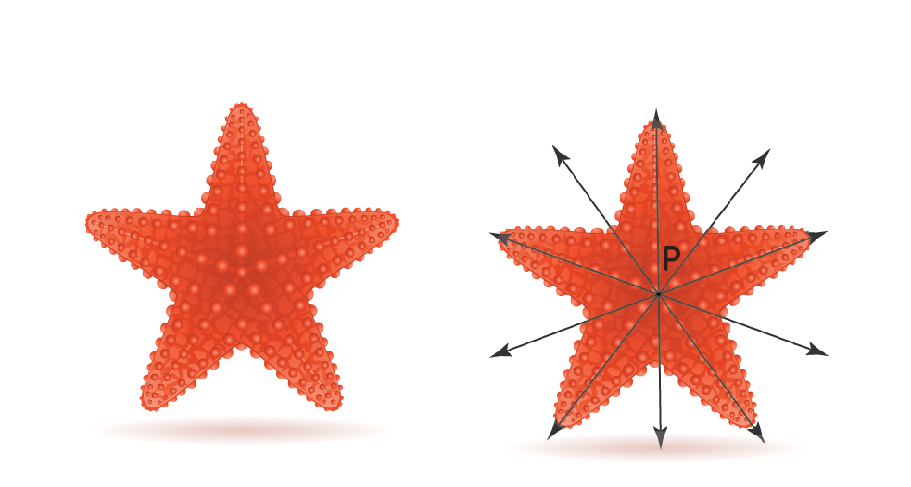
There are several forms in geometry that exhibit rotational symmetry. Figures like the circle, square, and rectangle, for example, show rotational symmetry. The shape of a starfish reflects rotational symmetry. The starfish will look topicIdentical across all directions if you spin or rotate it around a point. windmills, wheels, ceiling fans, etc.
Important points about rotational symmetry
⦁ The center of rotation is found when a figure rotates around a fixed point.
⦁ It may revolve in either a clockwise or counterclockwise direction.
⦁ The angle of rotation is the measurement of the angle we take when rotating. A full 360° rotation is also possible.
⦁ When the angle of rotation is 180°, it is referred to as a Half Turn, and when the angle is 90°, it is referred to as a Quarter Turn.
3. Reflective symmetry
Mirror symmetry, also known as reflective symmetry, is a sort of symmetry in which one half of an item reflects the other halves. Human body or face are almost similar on the left and right stopicIdes.
4. GltopicIde Symmetry
The mixture of translation and reflection transformations is known as gltopicIde symmetry. A gltopicIde reflection is commutative, which means that changing the order of the combinations has no effect on the gltopicIde reflection's outcome.